Study facts at a glance
Population and design: Thirty-six residents of two senior facilities, averaging 87 years old, participated in a randomized, double-blind comparison of retinol and vehicle on opposite arms. Source 3
Studied treatment: Study personnel applied topical 0.4% retinol lotion or vehicle up to three times weekly for 24 weeks; this describes the experiment, not a routine-use recommendation. Source 3
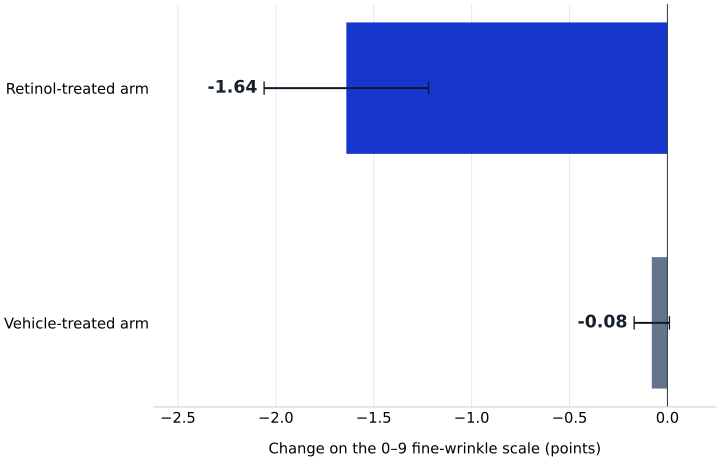
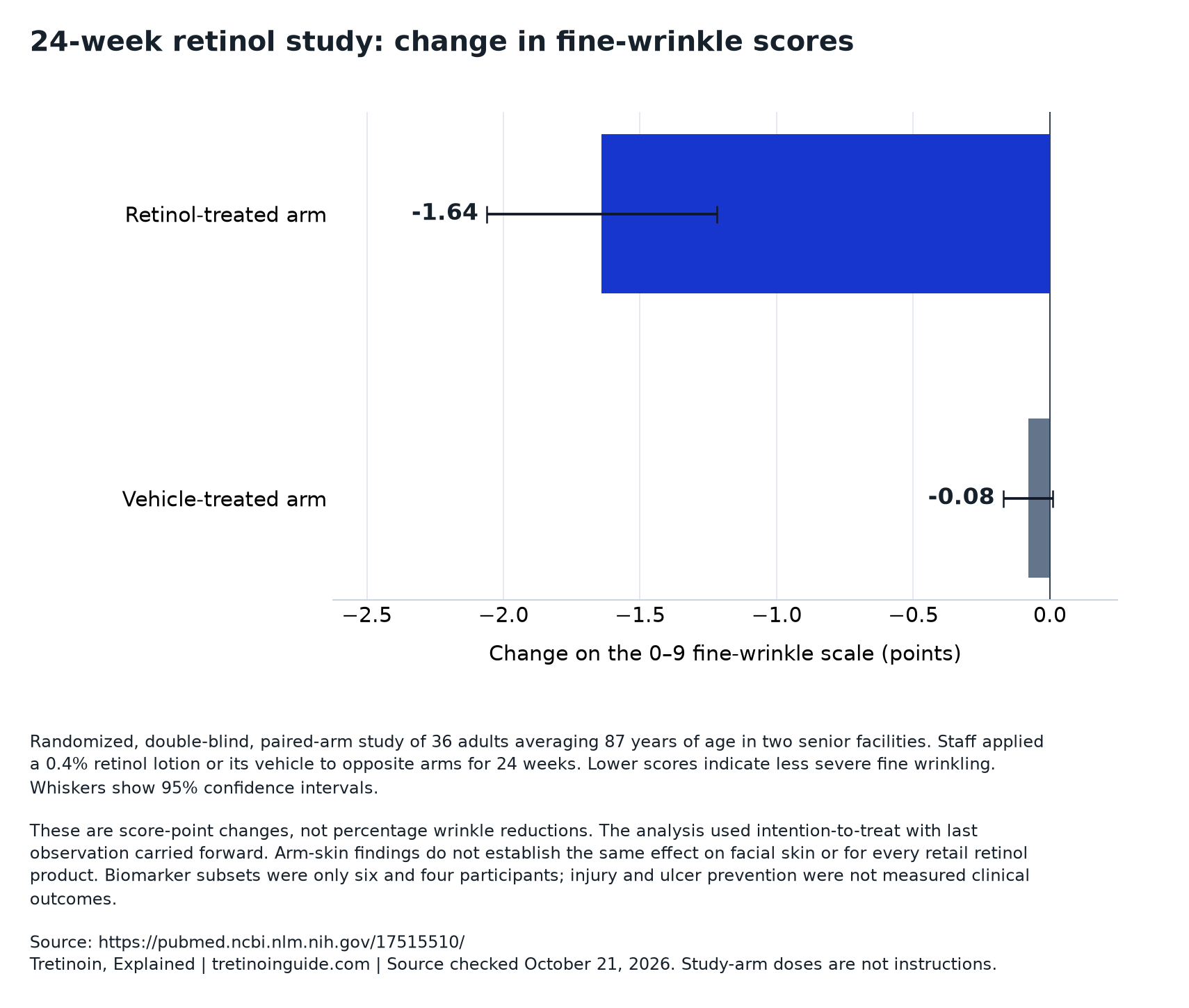
Fine-wrinkle result: Mean score changes were −1.64 with retinol and −0.08 with vehicle on a 0–9 severity scale, with lower scores indicating improvement. Source 3
Biopsy evidence: Glycosaminoglycan expression was assessed in a subgroup of six and procollagen I staining in a subgroup of four—not in all 36 participants. Source 3
Important boundary: The abstract does not provide complete adverse-event counts or demonstrate clinical prevention of injury or ulcers. Source 3
Why comparing two arms strengthens this small experiment
The study was randomized, double-blind, and vehicle-controlled, with left and right arms compared within the same person. Vehicle means the lotion base without the active retinol. This comparator matters because applying a lotion can affect skin independently of its active ingredient. The relevant question was therefore whether adding retinol produced more improvement than the base alone.
A within-person design also limits some differences that complicate comparisons between separate groups. Both arms share the participant’s age and many person-level characteristics. Randomization helps prevent systematic assignment of the active treatment to one side, while blinding is intended to reduce expectations influencing assessments. The abstract does not explain the allocation procedure or how successful blinding was.
The design does not turn 36 people into 72 independent participants. Measurements from opposite arms are related, and the experiment remains small. Its setting also matters: residents of two senior facilities received applications from study personnel. That is a more supervised treatment environment than ordinary self-directed use at home.
Read the underlying chart data: download CSV or download the source-labeled chart.
The lotion, treatment schedule, and skin location define the result
The active intervention was a topical lotion containing 0.4% retinol. Personnel applied it to one arm and vehicle to the other at visits, up to three times per week for 24 weeks. Those details identify the studied exposure. The abstract does not provide enough information to reconstruct every participant’s number of applications, interruptions, or cumulative exposure.
The study addressed naturally aged arm skin, not a facial-photoaging population selected for sun-related changes. Those categories can overlap biologically, but the measured location remains important. A result on arms cannot supply a numerical prediction for facial fine lines, deep wrinkles, pigmentation, or laxity when those outcomes were not established by this experiment.
Retinol is not tretinoin, also called all-trans-retinoic acid. Concentration percentages for different substances are not a common potency scale: 0.4% retinol cannot be converted into an equivalent tretinoin strength from these studies. The distinctions in the retinol, tretinoin, and compounding guide are useful when a product description places several different formulations under the broad term retinoid.
Reading the wrinkle scores without turning points into percentages
Clinical assessment used a semiquantitative severity scale from 0, meaning none, to 9, meaning most severe. Semiquantitative means an evaluator assigns a numerical category rather than measuring wrinkles in a physical unit such as millimeters. Fine wrinkling was the key reported clinical outcome; biochemical measurements supplied a separate line of evidence.
The mean change was −1.64 points with retinol, with a 95% confidence interval from −2.06 to −1.22. For vehicle, it was −0.08 points, with an interval from −0.17 to 0.01. The reported comparison had P<.001. The retinol interval lies entirely on the improvement side of zero, while the vehicle interval includes essentially no change.
Subtracting the reported mean changes gives a descriptive difference of 1.56 scale points favoring retinol. That calculation is not a separately reported estimate with its own confidence interval. Nor is −1.64 a 64% reduction: it is a change in scale points. Without baseline scores and a justified interpretation of proportional changes on this rating scale, a percentage claim would misrepresent the measurement.
What the reported retinol outcomes measure
| Outcome | Reported result | Correct interpretation |
|---|---|---|
| Retinol fine-wrinkle score | Change −1.64; 95% CI −2.06 to −1.22 | An average decrease in severity points, not a percentage reduction |
| Vehicle fine-wrinkle score | Change −0.08; 95% CI −0.17 to 0.01 | Little average change; the interval includes zero |
| Between-treatment comparison | P<.001 | Evidence against no treatment difference under the analysis assumptions, not a measure of effect size |
| Glycosaminoglycan expression | n=6; P=.02 | A biopsy-subgroup signal without a reported percentage increase |
| Procollagen I immunostaining | n=4; P=.049 | A small-subgroup marker result, not a whole-study collagen measurement |
Missing-data handling is part of the finding
The investigators reported an intent-to-treat analysis using last observation carried forward. Intent-to-treat generally aims to retain participants in their assigned comparison rather than analyzing only those who finish treatment exactly as planned. Last observation carried forward fills a later missing assessment with the participant’s most recent available observation.
That method does not mean there was no attrition. It also does not show that someone’s skin remained unchanged after the last actual examination. If improvement, worsening, or irritation influenced missing visits, carrying an earlier value forward could distort the endpoint. The direction and size of that distortion cannot be determined from the abstract.
The accessible report does not give the complete flow of participants, reasons for missing assessments, or alternative analyses under different missing-data assumptions. The reported statistical separation remains informative, but confidence intervals summarize sampling uncertainty under the chosen analysis; they do not automatically encompass uncertainty introduced by missing observations.
The biopsy findings suggest biology, not proven wrinkle causation
Biopsies were used to examine possible changes beneath the visible surface. Retinol increased glycosaminoglycan expression relative to vehicle in six participants, with P=.02. Glycosaminoglycans are substances associated with water retention in the skin’s supporting environment. This result is consistent with a possible contribution to changes in skin appearance, but it does not quantify hydration or explain each participant’s wrinkle response.
Procollagen I immunostaining increased relative to vehicle in four participants, with P=.049. Procollagen is a precursor involved in collagen production; immunostaining detects a marker in tissue. A change in staining is not interchangeable with a measured percentage increase in mature collagen, a quantified gain in skin thickness, or a demonstrated increase in mechanical strength.
The two subgroup results are biologically suggestive, especially alongside the clinical scores, but their small sizes limit precision and generalizability. The abstract supplies no effect-size confidence intervals for these measurements. Establishing that these pathways caused the visible improvement would require more than parallel changes in wrinkle ratings and tissue markers.
Injury resistance and ulcer prevention were hypotheses
The authors proposed that greater skin-matrix synthesis might help aged skin withstand injury and ulcer formation. That is a hypothesis about function, not a reported clinical outcome. The abstract does not describe counting skin tears, following wound healing, measuring ulcer incidence, or comparing injury rates between treated and control arms.
This distinction is especially important in a population averaging 87 years old. An improvement in appearance and a laboratory marker could motivate a trial of skin resilience, but neither establishes that fewer injuries occur. Demonstrating prevention would require a study designed around actual injury or ulcer outcomes, with sufficient participants and follow-up.
Age also needs careful wording. A mean of 87 does not mean every participant was 87 or that all age groups within the study benefited equally. The abstract does not provide an age range or age-specific effects. The related guide to tretinoin evidence after 65 helps separate enrollment ages from evidence about particular age groups.
The 48-week tretinoin trial separates thickness from appearance
A different double-blind, vehicle-controlled study followed facial photoaging for 48 weeks. Ninety-nine patients completed treatment: 32 using 0.1% tretinoin cream, 35 using 0.025%, and 32 using vehicle, applied once daily. The available abstract does not state randomization, so it should not be added to the design description.
Both tretinoin concentrations improved facial photoaging relative to vehicle, with no clinically or statistically significant efficacy difference reported between the active concentrations. Epidermal thickness increased by 30% and 28%, respectively, compared with an 11% decrease with vehicle. These are tissue-thickness changes—not percentages of wrinkles removed. Vascularity also increased, while measured immune markers showed no significant treatment-versus-vehicle changes.
Redness and scaling were significantly greater with 0.1% than with 0.025% tretinoin. Similar clinical improvement despite different irritation levels argues against irritation being the sole driver of benefit, without proving a complete mechanism. The close reading of the concentration trial explores this distinction. It does not establish that either tretinoin concentration is better or worse than the retinol lotion.
Three experiments with different drugs, locations, and follow-up
| Study | Population and exposure | What it contributes |
|---|---|---|
| 24-week retinol study | 36 older adults, mean age 87; arm skin; 0.4% lotion versus vehicle, up to three applications weekly | Fine-wrinkle scores and small biopsy subgroups in naturally aged skin |
| 48-week tretinoin study | 99 completers with facial photoaging; 0.1% or 0.025% cream versus vehicle, once daily | Clinical improvement, epidermal thickness, and differing irritation between concentrations |
| Two-year tretinoin study | 204 subjects with moderate to severe facial photodamage; 0.05% emollient cream versus vehicle, once daily | Longer clinical follow-up, tissue safety assessments, and a month-12 procollagen marker |
Two-year follow-up adds evidence without extending the retinol trial
The longer randomized, placebo-controlled tretinoin trial treated 204 subjects with moderate to severe facial photodamage. Participants used 0.05% tretinoin emollient cream or its vehicle on the entire face once daily for up to two years. Clinical and tissue assessments occurred at scheduled visits, making this a longer observation window than either the retinol study or the concentration comparison.
Tretinoin produced significantly greater improvement in fine and coarse wrinkling, mottled hyperpigmentation, lentigines, sallowness, overall photodamage severity, and investigator-rated response, with reported P values below .05. The abstract does not supply numerical effect sizes or confidence intervals for these clinical outcomes. Consequently, it establishes statistical differences without allowing a precise comparison of their magnitude with the retinol score change.
Tissue evaluation found no increase relative to vehicle in keratinocytic or melanocytic atypia, dermal elastosis, or adverse stratum-corneum effects. These describe selected microscopic safety findings, not absence of every adverse effect. A procollagen-synthesis marker increased at month 12, with P=.0074. None of this measures durability after stopping retinol or extends its 24-week findings to two years.
Safety numbers must stay attached to the product studied
The retinol abstract does not give complete irritation counts, severity categories, or adverse-event discontinuations. It therefore cannot support a claim of zero irritation or universal tolerability. Likewise, adverse-effect rates from prescription tretinoin studies cannot be assigned to this retinol lotion. Different active ingredients, bases, locations, and exposures prevent that substitution.
Official labeling for RENOVA 0.02% tretinoin cream provides concrete safety information for that exact product. Among 339 treated patients in double-blind, vehicle-controlled studies, almost all reported one or more local reactions. In 32%, irritation was severe, prompted temporary discontinuation, or led to mild topical corticosteroid use—a combined category, not a 32% rate of severe irritation alone. About 4% discontinued because of adverse reactions.
The label also describes burning, stinging, peeling, redness, itching, and heightened sunburn susceptibility, and states that the product should not be used during pregnancy. Its geriatric discussion covers ages 65–71 and says safety and effectiveness above 71 have not been established. That does not contradict a retinol study averaging 87: it concerns a different drug product. The prescription-label guide explains how to keep these boundaries visible.
Translate the evidence into questions, not product equivalence
The strongest practical question is whether a proposed product matches the evidence in active ingredient, formulation, intended outcome, skin location, and population. The retinol trial supports its studied lotion under its study conditions. It does not validate every over-the-counter retinol product, compounded preparation, oral route, or commercial care service. The indexed abstracts do not identify trial sponsors, so sponsorship cannot be confidently assigned from these records.
RENOVA 0.02% labeling is narrower than a general claim of reversing skin aging: it describes mitigation of fine facial wrinkles as an adjunct to comprehensive skin care and sunlight avoidance. Its labeling also states that daily safety and effectiveness beyond 52 weeks have not been established for that product. A two-year study of 0.05% emollient cream should not silently overwrite the 0.02% label.
Editorial interpretation: commercial decisions should distinguish the treatment evidence from the agreement being purchased. The Curology review and Dermatica review can be used to check documentary terms, not to infer that either service offers the studied product or reproduces its outcomes. Questions about follow-up, formulation identification, and renewal obligations remain separate from whether a trial detected wrinkle improvement.
Source 3 Source 2 Source 4 Source 1
Questions about the evidence
Does the study show that retinol works in very old adults?
It supports improvement in fine-wrinkle ratings on arm skin in a small group averaging 87 years old. That is direct evidence in an unusually old population, but not proof of equal benefit at every age, on the face, or with every retinol formulation. The abstract does not provide age-specific response estimates.
How noticeable was a 1.64-point improvement?
It was an average reduction on an evaluator-rated 0–9 severity scale. The abstract does not provide a patient-defined threshold for a worthwhile visible change or the proportion who considered the result satisfactory. Statistical evidence of improvement is therefore clearer than the answer to how noticeable it would feel to an individual.
Do the biopsies prove that retinol rebuilt collagen?
They showed increased procollagen I staining in four participants, which supports a signal related to collagen production. They did not quantify mature collagen gain across all 36 participants or prove that collagen changes caused the wrinkle improvement. The glycosaminoglycan analysis included six participants.
Is stronger tretinoin necessarily more effective for photoaging?
Not in the 48-week comparison described here: 0.1% and 0.025% produced similar reported clinical improvement, while 0.1% caused more redness and scaling. That result is specific to those creams and that study. It neither establishes universal concentration equivalence nor supplies a conversion between tretinoin and retinol.
Did the retinol benefit persist after treatment ended?
The indexed abstract reports the 24-week treatment result, not a post-treatment durability assessment. The two-year tretinoin trial concerns a different intervention during longer treatment. RENOVA labeling discusses possible loss of some benefit after discontinuation, but that product-specific observation cannot establish how long this retinol lotion’s effects lasted.
What this evidence supports
The retinol study provides credible, narrowly defined evidence: a randomized within-person comparison found improved fine-wrinkle scores with a specific 0.4% lotion on naturally aged arm skin over 24 weeks. Its design is stronger than an uncontrolled before-and-after comparison, while its small size, missing-data method, limited safety reporting, and tiny biopsy subgroups constrain interpretation. Longer tretinoin trials add useful evidence about facial photoaging, tissue changes, and irritation, but they are not extensions of this experiment. The clearest conclusion is improvement in a measured cosmetic outcome—not quantified rejuvenation, proven injury prevention, or equivalence among products.
Research access and limitations
This analysis relies on indexed original research abstracts for the three trials and full official RENOVA 0.02% labeling. Complete trial protocols, participant-flow details, full adverse-event tables, and supplements were not examined. Trial sponsorship was not identified in the accessible abstracts; the label identifies Bausch Health US LLC as RENOVA’s distributor, not as the established sponsor of these trials.